Case study: Building personas and developing a value proposition
Uresta is a manufacturer and provider of a pessary that significantly reduces or stops leaks caused by female Stress Urinary Incontinence (SUI). The company has had success in both the Canadian and U.S. markets, particularly through online sales and partnerships with medical distributors. Their key value propositions include the product’s reusability, ease of use and all-day comfort for women.
What was Uresta’s key research need?
The team at Uresta wanted to boost conversion for online sales through their website and improve their value proposition. The MaRS Market Intelligence (MI) team worked with Uresta to:
- Understand Uresta’s target market in Canada
- Evaluate perceptions around pricing and product value
- Build Uresta’s key personas
By developing personas, Uresta was able to align their marketing strategy with their ideal customer’s unmet needs and buying criteria.
Our research process: Coding interviews and building personas
Uresta hypothesized their ideal customer was over 30 years old and enjoyed a socially and physically active lifestyle. Uresta wanted to investigate how these traits related to the severity of the participant’s SUI and their likelihood of using Uresta to manage their condition. To test the venture’s hypothesis, the MaRS MI team:
- Conducted 30-minute interviews with 10 participants, split into two age groups (30 to 50, 50+)
- Coded the interview data and used thematic analysis to identify key insights
- Built two customer personas using key insights gathered through participant interviews
Summary of research process
The MaRS MI team engaged with the User Interviews research platform to recruit potential participants. The team created two age-based participant groups and used a variety of screening questions to identify the best candidates that represented women living with SUI in Canada.
To uncover Uresta’s ideal customers through interviewing, the MaRS MI team designed a discussion guide that explored participants’ personalities, lifestyles, purchasing behaviours and SUI history. The last section of the guide was structured around a demo of Uresta’s website to explore the participants’ unbiased reactions to Uresta’s website messaging, product video, FAQ page, promotional materials and pricing.
Discussion guide question categories
| Participant behaviour | Career, income, hobbies, physical activity, family, social media use, favourite brands |
| SUI experiences | Condition severity, current management, openness about condition, condition sentiments (resignation/denial/assertion) |
| Product perception | Response to marketing and educational material, unmet needs |
| Pricing preferences | Current spending on treatments, perception of product value, willingness to spend, importance of insurance coverage |
Building personas
After completing the interviews, the MaRS MI team identified the key behavioural variables seen throughout the interviews and assigned them colour codes. They used colour codes to highlight recurring themes and sub-themes from each participant group, while also tracking their rate of occurrence.
Colour codes and themes identified through participant interviews
| Themes/Patterns | Sub-themes |
| Condition & treatments | Leak frequency |
| Current management strategies | |
| Attitude toward condition | |
| Lifestyle | Physical activity |
| Openness with others | |
| Favourite brands | |
| Discovery | Condition and treatment |
| Research strategies | |
| Social media use | |
| Willingness to pay | Likelihood of trying Uresta |
| Importance of insurance | |
| Pricing sentiments | |
| Product response | Ease of usability |
| Fit and comfort | |
| Satisfaction guarantee |
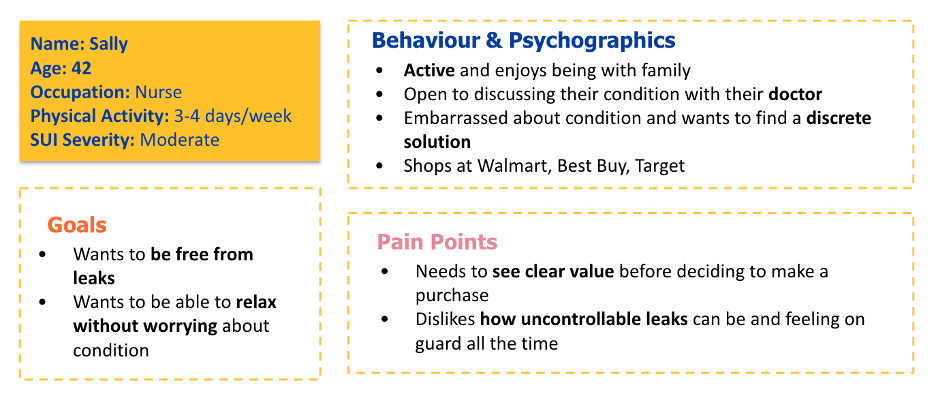
The key themes and sub-themes identified were mapped against the participants’ demographic traits. Commonly aligned themes and demographics were used as the foundations for building Uresta’s two personas. The following elements were used to illustrate each persona:
- Persona name
- Base demographics (age, family, occupation)
- Goals and needs
- Pain points
- Behaviours
- Key quotes
Example template for persona building
Conclusion: Personas and actionable insights
One of the two personas created aligned strongly with Uresta’s hypothesis, proving that their ideal customer was in fact over 30 years old and enjoyed a socially and physically active lifestyle. The second persona was less physically active and social than the first persona, but still showed interest in Uresta’s product.
Both personas provided valuable insights on ways Uresta could improve their messaging on their website that would address their potential customers’ pain points, like finding SUI products that fit them comfortably. While the analysis indicated the more active persona was more likely to try Uresta, strong feedback from both groups showed shared concerns, including the current pricing acting as a barrier for interested customers.
Uresta’s next steps and feedback
In response to the insights communicated through the MaRS MI team’s research, Uresta made changes to their pricing strategy, as well as their product’s marketing messaging. New material on Uresta’s website was tailored to address common pain points seen in both personas, such as finding the best size to buy and achieving a comfortable fit for all-day use. Uresta was able to target their ideal customers’ concerns and begin boosting conversion through their website.
“Provided helpful insights that are unbiased and challenged our thinking and also helped confirm some of our thoughts. It is great to have a third party, unbiased opinion vs. relying on your internal team for the same research and insights.” – Uresta, CEO
Primary research engagements can provide your startup with targeted and original data that will provide key insights on your ideal audience and empower impactful marketing strategies. If your startup is looking to understand their target customer and market segments, the MaRS MI team can help.
 Sarah Janer